Looking for ready-to-use resources that will save you hours of preparation time? Our extensive collection of FREE worksheets covers every Content, Context, and Concept in the course and we’ve even included the Research Methods and Data Analysis and Interpretation topics.
What makes these worksheets special?
Each worksheet is written to provide complete coverage of its topic. Students will find clear definitions, detailed explanations, and thoughtful discussions that build genuine understanding. But we don’t stop at theory, every worksheet includes engaging questions that reinforce learning and encourage critical thinking.
Flexibility for your teaching
Here’s the game-changer: these worksheets are provided as Word documents, not PDFs. This means you can download them and customize them to perfectly suit your teaching style, your students’ needs, and your specific classroom situations. Edit questions, add examples relevant to your students’ experiences, or adjust the difficulty level: the choice is yours. But they’re ready to use without any edits.
Comprehensive coverage
With one (and often two) worksheets available for every topic, you’ll have everything you need to support student learning throughout the course. From Biological to Sociocultural, from Research Design to Statistical Analysis… it’s all here.
Download your FREE worksheets today and spend less time creating materials and more time enjoying yourteaching.
Here’s a question that’s been bouncing around: ‘What do we mean when we say psychology is conceptual?’
It sounds like academic jargon, I know. But stick with me, because this idea gets right to the heart of what makes psychology such a fascinating and essentially human field.
What ‘conceptual’ means
When we say psychology is conceptual, we’re pointing to something fundamental: the things psychologists study aren’t sitting out there in nature waiting to be discovered, like gold deposits or new species of beetle.
Think about it. ‘Memory’, ‘aggression’, ‘intelligence’, ‘attachment’, ‘depression’… these are all human-created concepts. We invented them. We drew the boundaries. We decided what counts as ‘aggression’ versus ‘assertiveness’, where ‘normal anxiety’ ends and ‘anxiety disorder’ begins, and what behaviors signal ‘secure attachment’.
These aren’t discoveries of pre-existing, naturally occuring things. They’re useful ways we’ve carved up the messy, continuous reality of human behavior.
Concepts change with time and culture
Here’s where it gets interesting. If psychological concepts were natural features, fixed features of reality, they’d be universal and unchanging. And of course, they’re not.
The concept of ADHD didn’t exist 100 years ago. ‘Hysteria’ was once a major diagnostic category; now it’s vanished from our textbooks. Different cultures conceptualize mental states in different ways. Some languages don’t even have a word that maps onto our concept of ‘depression’.
Our psychological concepts are also theory-laden. When we talk about ‘working memory’, we’re not just describing something neutral, we’re buying into a particular model of how cognition works. When Freudians spoke of ‘ego defence mechanisms’, they were smuggling in a whole theoretical framework.
So what’s the alternative?
If psychology is conceptual, what would it look like if it weren’t?
The alternative would be studying human behavior and experience as purely physical or biological phenomena. We’d focus only on directly measurable, observer-independent entities: neurons firing, neurotransmitter concentrations, brain structures, hormone levels, reaction times, genetic markers…
This would be neuroscience or physiology: concrete, physical, and measurable.
The problem is…
The problem is that most of what makes us human: love, identity, grief, creativity, the search for meaning…, these can’t be fully captured by purely physical descriptions.
You could give me a complete neural map of everything happening in someone’s brain during grief. Every synapse, every chemical cascade, every pattern of activation. And yet that description wouldn’t capture what grief is as a human experience. It wouldn’t tell you what it means to lose someone you love.
Living in the tension
This is why psychology occupies such uncomfortable territory. It sits between the natural sciences, which study observer-independent physical phenomena, and the human sciences, which study meaning-laden, conceptual phenomena.
Psychology is both at once. It studies real biological processes and culturally-situated concepts. It measures objective behaviors and interprets subjective meanings. It discovers and constructs.
This creates unique methodological and philosophical challenges. But it’s also what makes psychology interesting. We’re not just measuring things; we’re constantly negotiating what those things even are.
And that’s not a weakness. It’s the nature of studying something as complex, dynamic, and meaning-soaked as human experience.
What do you think? Does recognizing psychology as conceptual make it less scientific or does it make it more honest about what science of the human mind can actually be?
One of the quiet revolutions in teaching IB Psychology is this: our students no longer need to memorise outlines of 200 or more studies, each with two strengths and two limitations. That’s worth celebrating. It makes our subject lighter, more engaging, and far more relevant. Students can now focus on developing critical thinking, connecting concepts, and applying their knowledge rather than playing flashcard games with endless lists of studies.
But let’s not forget: research is the scientific foundation of psychology.
Would you teach ethics in psychology without telling your students about Little Albert and the white rat, Zimbardo’s appalling Stanford Prison Study, or Milgram’s not-so-appalling obedience experiments? Of course not. These are the stories that not only illustrate concepts but also bring to life the ethical debates that shape our subject.
Would we introduce social identity theory without Sherif’s Robbers Cave study? Could we possibly explain observational learning without Albert Bandura’s endlessly punched Bobo doll? And when we turn to methods, what better way to anchor quasi-experiments and neuroplasticity than Eleanor Maguire’s London taxi drivers, or to illuminate the case study method than Henri Molaison, whose memory loss is legendary?
The point is simple: research gives psychology its credibility.
Yes, assessment criteria don’t explicitly require studies by name. Students aren’t graded on whether they remember that it was 22 boys in Sherif’s camp or 72 children in Bandura’s playroom. But to teach any of the IB Psychology concepts with integrity, we must draw upon the research that produced them. Without robust studies and their conclusions, our discipline risks floating away into abstraction, detached from the science that grounds it.
So let’s celebrate freedom from rote memorisation, but let’s also celebrate the research itself. Studies are not an add-on; they are the very evidence that makes psychology worth studying.
Whether you’re in your very first year of teaching IBDP Psychology or your thirtieth, in some ways it doesn’t matter. You’re standing in front of a new set of students. Fresh faces, fresh questions, and—if we’re honest—fresh challenges.
Same but different.
Maybe you’re teaching in the same school you once sat in as a student yourself, or maybe you’re on the other side of the globe—Morocco, Mauritius, Oman, Albania. Again, that’s not really the point. Because teaching, at its heart, is about guiding and supporting your students, wherever you happen to be.
Yes, I know… the year will kick off with a few staff meetings. Some will be useful. Others… well, let’s just say “less so.” If you find yourself in one of those, you could quietly plan a lesson or even play a quick game of chess from the back row. (Not that I’m encouraging mischief, of course.)
Your first lessons aren’t about ploughing through the syllabus—they’re about setting the tone. Letting students (and their parents) know they’re in safe, well-prepared hands.
You might kick off with an introduction to the experimental method—perhaps demonstrating the Stroop Effect to show how something as simple as reading a word can become surprisingly tricky when colour and meaning clash.
Or you might spark a discussion about human behaviour:
Why are some people passionately in favour of immigration to the UK, while others are equally passionately opposed?
Why do some students show up every single day, while others are unfazed by missing lessons?
Why are some people shy while others brim with confidence?
Or perhaps you want to open with ethical considerations—just a quick, engaging chat about Zimbardo’s prison study or Watson and Rayner’s famous “Little Albert” experiment. You could even take your students into the playground to observe younger children for prosocial behaviours—psychology in action from day one.
Whatever you choose, choose something that excites you. That enthusiasm is contagious.
And, you know, take very good care of yourself.
So here’s to the start of your year—new students, new questions, new discoveries. Wherever you are in the world, whatever your teaching style, we’re wishing you all the very best.
We’re excited to share a new (and free) resource created to support teachers and students in the new IB Diploma Psychology course: “How to answer exam questions.”
This document will demystify the exam requirements across Papers 1, 2, and 3. It provides clear, structured guidance on how to approach every question.
Step-by-step structures for each question
Tips for content selection and writing focus
The document is provided in Word format so you can copy and edit it to suit your purposes or share it directly with your students. A suggested use: Give a copy to students when they are doing practice exams so they can see exactly how to structure their responses.
We hope this document helps make exam preparation a little smoother for everyone. Feel free to share it with colleagues.
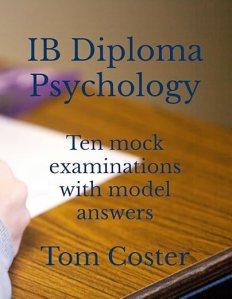
If you’re looking for even more comprehensive support, check out our book IB Diploma Psychology – Ten Mock Examinations with Model Answers. It includes TEN full mock exams (Papers 1, 2, and 3) complete with high-scoring sample responses for every question. Use it to plan your mocks, guide student revision, and sharpen your understanding of exactly what to teach for exam success.
Real answers to your IBDP Psychology exam questions
Struggling to figure out how much students need to write to get full marks? Wondering whether research studies are essential in exam answers? Curious how the new Class Practicals actually relate to the Paper 3 questions?
You’re not alone—and now, you don’t have to guess because here’s an essential resource for the new IBDP Psychology course: A book of TEN complete exams (Standard and Higher Level), complete with high-scoring sample responses for every paper. TEN separate exam papers – use them for exam preparation lessons and for your end of year practice/mock exams.
This is the guide every teacher and student has been waiting for.
Detailed examples of full-mark answers—so students know exactly what ‘excellent’ looks like.
Clear guidance on how much to write, how to structure responses, and what the examiners expect.
Smart insights into whether and how to use research studies in your answers.
A clear link between the Class Practicals and how they prepare students for the demands of Paper 3.
Whether you’re teaching the course or preparing to sit the exam, this book takes the mystery out of assessment and replaces it with confidence, clarity, and results.










 Tom Coster - Psychology