Tag: exams IBDP exams

  • Why Research Studies Still Matter in Teaching Psychology


    One of the quiet revolutions in teaching IB Psychology is this: our students no longer need to memorise outlines of 200 or more studies, each with two strengths and two limitations. That’s worth celebrating. It makes our subject lighter, more engaging, and far more relevant. Students can now focus on developing critical thinking, connecting concepts, and applying their knowledge rather than playing flashcard games with endless lists of studies.

    But let’s not forget: research is the scientific foundation of psychology.

    Would you teach ethics in psychology without telling your students about Little Albert and the white rat, Zimbardo’s appalling Stanford Prison Study, or Milgram’s not-so-appalling obedience experiments? Of course not. These are the stories that not only illustrate concepts but also bring to life the ethical debates that shape our subject.

    Would we introduce social identity theory without Sherif’s Robbers Cave study? Could we possibly explain observational learning without Albert Bandura’s endlessly punched Bobo doll? And when we turn to methods, what better way to anchor quasi-experiments and neuroplasticity than Eleanor Maguire’s London taxi drivers, or to illuminate the case study method than Henri Molaison, whose memory loss is legendary?

    The point is simple: research gives psychology its credibility.

    Yes, assessment criteria don’t explicitly require studies by name. Students aren’t graded on whether they remember that it was 22 boys in Sherif’s camp or 72 children in Bandura’s playroom. But to teach any of the IB Psychology concepts with integrity, we must draw upon the research that produced them. Without robust studies and their conclusions, our discipline risks floating away into abstraction, detached from the science that grounds it.

    So let’s celebrate freedom from rote memorisation, but let’s also celebrate the research itself. Studies are not an add-on; they are the very evidence that makes psychology worth studying.


  • A New School Year – Wherever You Are

    Whether you’re in your very first year of teaching IBDP Psychology or your thirtieth, in some ways it doesn’t matter. You’re standing in front of a new set of students. Fresh faces, fresh questions, and—if we’re honest—fresh challenges.

    Same but different.

    Maybe you’re teaching in the same school you once sat in as a student yourself, or maybe you’re on the other side of the globe—Morocco, Mauritius, Oman, Albania. Again, that’s not really the point. Because teaching, at its heart, is about guiding and supporting your students, wherever you happen to be.

    Yes, I know… the year will kick off with a few staff meetings. Some will be useful. Others… well, let’s just say “less so.” If you find yourself in one of those, you could quietly plan a lesson or even play a quick game of chess from the back row. (Not that I’m encouraging mischief, of course.)

    Your first lessons aren’t about ploughing through the syllabus—they’re about setting the tone. Letting students (and their parents) know they’re in safe, well-prepared hands.

    You might kick off with an introduction to the experimental method—perhaps demonstrating the Stroop Effect to show how something as simple as reading a word can become surprisingly tricky when colour and meaning clash.

    Or you might spark a discussion about human behaviour:

    • Why are some people passionately in favour of immigration to the UK, while others are equally passionately opposed?
    • Why do some students show up every single day, while others are unfazed by missing lessons?
    • Why are some people shy while others brim with confidence?

    Or perhaps you want to open with ethical considerations—just a quick, engaging chat about Zimbardo’s prison study or Watson and Rayner’s famous “Little Albert” experiment. You could even take your students into the playground to observe younger children for prosocial behaviours—psychology in action from day one.

    Whatever you choose, choose something that excites you. That enthusiasm is contagious.

    And, you know, take very good care of yourself.

    So here’s to the start of your year—new students, new questions, new discoveries. Wherever you are in the world, whatever your teaching style, we’re wishing you all the very best.

    —Tom


  • Class practicals in the new DP Psychology course – are…

    …a piece of cake!

    The new IBDP Psychology syllabus introduces “Class Practicals” — and understandably, many teachers are expressing some concern. But there’s good news: they’re not as big a deal as they might seem.

    First, students don’t need to each design and carry out four practicals independently. These are class activities, best done together during regular class time or in school, using the 4 research methods to prepare for Paper 1 Section B. The aim is to build understanding of experimental design, data collection, and critical thinking — not to create publishable research.

    Each of the four required Class Practicals aligns with a key method in the syllabus: experiment, observation, interview, and survey/questionnaire. Teachers are encouraged to guide the design and implementation, ensuring all students participate and reflect on the process.

    If you’re looking for support, Tom Coster’s IBDP Psychology: The Textbook is a must-have. It provides clear explanations, guidance, and a ready-to-use example for each practical. With good planning and a collaborative classroom approach, these activities can be both manageable and meaningful.


  • A real-world issue for the in-class practicals

    The new IB Diploma Psychology course requires students to take part in four teacher-guided in-class practicals: an interview, an experiment, an observation, and a survey/questionnaire. We’re looking for issues that feel real and relevant to our students, and few topics are more urgent right now than the mental health crisis among young people.

    A recent UN-commissioned study by Jean Twenge and David Blanchflower has revealed a shocking reversal of the traditional “U-shaped” wellbeing curve. Happiness no longer dips in midlife—it now rises steadily with age, while young people are reporting record-low levels of life satisfaction. In six major English-speaking countries (UK, US, Ireland, Australia, Canada, and New Zealand), wellbeing among teenagers has plummeted—especially for young women.

    Teenager wellbeing

    One clear suspect? Smartphones and social media.

    This trend didn’t start with COVID-19. It dates back to around 2013 and has only worsened. Young people are reportedly more isolated, less socially engaged, and more exposed to cyberbullying and body shaming.

    This is exactly the kind of real-world phenomenon that DP Psychology students could—and should—investigate through in-class practicals. Imagine students designing ethical, small-scale studies examining screen time, social media use, and indicators of wellbeing among peers. It’s relevant, measurable, and personally meaningful to them.

    But maybe there are other possibilities, such as a shortage of good quality sleep. Diet? The mass media? The topsy-turvy economy and jobs market? Or maybe the teenage years were never really the greatest time of our life.

    We may not solve a global crisis in one classroom, but maybe we will start asking the right questions.

    Smartphones? Lack of sleep? Mass media? Music? Exams? Or maybe it’s ‘just a phase’

    Note that our Textbook includes a detailed section including examples of the In Class Practicals.


  • IB Psychology Examinations

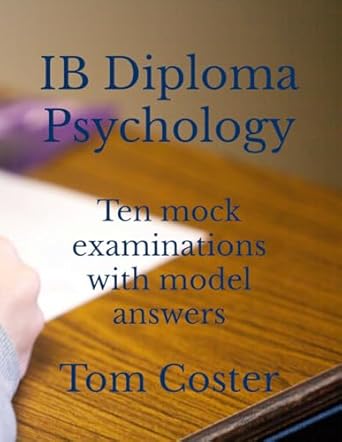
    Preparing students for the IB Diploma Psychology exam can be a challenge, but IB Diploma Psychology: Ten Mock Examinations by Tom Coster is the essential resource to ensure success. This book provides ten meticulously designed mock exams that mirror the structure, difficulty, and content of the real IB assessments, offering students the most authentic practice experience possible.

    Teachers will appreciate how this resource aligns with the IB Psychology Subject Guide and Teacher Support Material, making it a perfect companion for classroom revision. With realistic time allocations, model answers, and success strategies, students gain valuable insights into exam techniques, structuring high-quality responses, and integrating research evidence effectively.

    By using this book, teachers can provide their students with practical, targeted preparation, helping them approach the exams with confidence. With comprehensive syllabus coverage and expert guidance, this resource is the key to maximizing student achievement in IB Psychology.